
This is an owners service/repair manual for Batavus Mopeds from 1976 to 1978. This is an original unused manufactuers manual not a reprint. 98 pages with full diagrams and instructions written in english. Some Batavus Motorcycle Manuals PDF above the page - M48 Starflite, M56 Regency Laura. BATAVUS was founded in 1904. Now making only bicycles. Batavus is one of the two most prestigious Dutch companies. The second is Gazelle, it is like Mercedes and BMW in Germany among cars. This is an owners service/repair manual for Batavus Mopeds from 1976 to 1978. This is an original unused manufactuers manual not a reprint. 98 pages with full.
View and Download Batavus VA manual online. VA motorcycle pdf manual download. Also for: Hs 50. Batavus Moped Workshop Service Manual for V.A. Top Rated Seller Top Rated Seller. From United States +C $25.34 shipping.
Batavus Intercycle Corporation was the leading manufacturer of bicycles and mopeds in Holland during the 1970s. During its most productive years, the company’s 350,000 sq. ft. Herereveen, Holland plant employed 700 craftsmen to produce 70,000 Batavus mopeds and 250,000 bicycles a year. During this time the Batavus was exporting 55% of its production with the remainder going to Holland which had more than two million mopeds on the roads as of 1977.
Origins
Batavus originated in 1904, when Andries Gasstra opened a shop in Heereveen, selling clocks, watches and sewing machines. Bicycles were soon added to the catalogue as two-wheeled transport gained in popularity, and the original business was discontinued when Gastra acquired the sole Dutch representation for the German bicycle, Presto. He later started selling bicycles under his own brand name, Batavus.
Bicycle with a motor
During the 1930’s, Batavus began making three-wheeled transport bicycles equipping them with an engine a few years later. At the same time they produced their first motorcycles. By 1940, when Holland was invaded, Batavus employed some 120 people. Post-War, the company made rapid strides and a new project which had started out as a bicycle with a motor was soon developed into a functionally designed motorized two-wheeler, with front and rear-wheel suspension for riding comfort and a creditable performance. Long-distance rides on Batavus machines were taken through the United States, and to places like Morocco, Alexandria and Baghdad, to help popularize the name outside Holland.
Post-war growth and expansion
By 1954, the company was operating from an assortment of buildings, producing a variety of machines, but in 1956, just 52 years after Andries Gasstra opened his shop, a new factory was opened in the industrial park in Heerenveen. The new factory had an area of 6000 square meters and the workforce had grown to 300. Further extensions and developments became necessary and today the company employs about 650 people in a modern factory which uses advanced design and manufacturing techniques. After the new premises were opened the company continued primarily to be a bicycle manufacturer and benefited from the growing demand for bicycles, not only in Holland, but all over the world. However, in 1969, Batavus acquired the bicycle and motorcycle production of another Dutch company, Magneet, and in the following year took over an amalgamation of three famous three-wheeler factories in Germany. Although their sales of motorised two-wheelers were subjected to increasing fluctuation, with various model and style changes, there was steady growth every year.
World-wide distribution
In 1970, Batavus joined the Dutch Laura industrial group, which includes Laura Motoren, and Laura Engines were used on all Batavus mopeds in the UK, except the Sachs powered sports machine, the Mk 4S.. First imports to the UK were in 1973, with the setting up of Harglo Ltd. by two former BSA/Triumph executives, Wilf Harrision and Peter Glover. Their primary function as sole concessionaires to Batavus is to import and distribute Batavus mopeds in the UK and Ireland. The early Go-Go V was a rigid frame machine, which was discontinued, but after the introduction of the Go-Go VA, four new machines were added to the UK market in 1974 and two more in 1976. By this time the company had won a reputation for the manufacture of good quality, well made and well finished machines, which, while not the cheapest, are good to look at and offered little maintenance trouble.
At the Earls Court, London, Show in 1976, Batavus showed their seven-model range; six of those machines were powered by the well known 48cc Laura engine, with V-belt primary drive and automatic clutch. The exception was the top-of-the-range Mk 4S, being the Rolls-Royce of sports mopeds with motorcycle styling and the famous Sachs four-speed power unit. Specifications for that machine include an electronic tachometer, battery-operated turn signals and heavy-duty suspension front and rear. This model, which has the overall dimensions of a full-sized motorcycle was the biggest machine sold by Batavus.
As early as 1972 their total production of bicycles was 250,000 and that of mopeds 60,000, within that year. Of these, 60,000 bicycles and 27,000 mopeds were sent abroad. Sales were particularly strong in West Germany and Switzerland. Other important outlets are Iran, Israel, Belgium and Greece. In Turkey, Batavus mopeds began to be manufactured under license in 1972. In 1977, Batavus made more bicycles and mopeds than any other company in the Netherlands. They were the biggest Dutch exporter of machines, with 55 percent of their total production going outside Holland to accommodate a surge in interest for fuel efficient transportation in the states during the 70’s (Batavus setup it’s Batavus USA headquarters in Atlanta, GA).
Moped models/specifications
The power plant of most Batavus models is the Laura M48 motor, a 48cc/2.4bhp engine (with the exception of the Mk 4S which is powered by a Sachs engine, and the Batavus Gran Prix which is powered by a Peugeot 103 engine,), and the Laura M56 48cc engine, which have a fuel consumption of approximately 150 miles per gallon.
Each includes a tubular steel frame, a suspension system of telescopic shock absorbers in the rear, and stainless steel fenders in both the front and back. Each comes with an illuminated speedometer/odometer, electric horn, lockable steering, drum brakes in the front and rear and 16-inch moped tires.
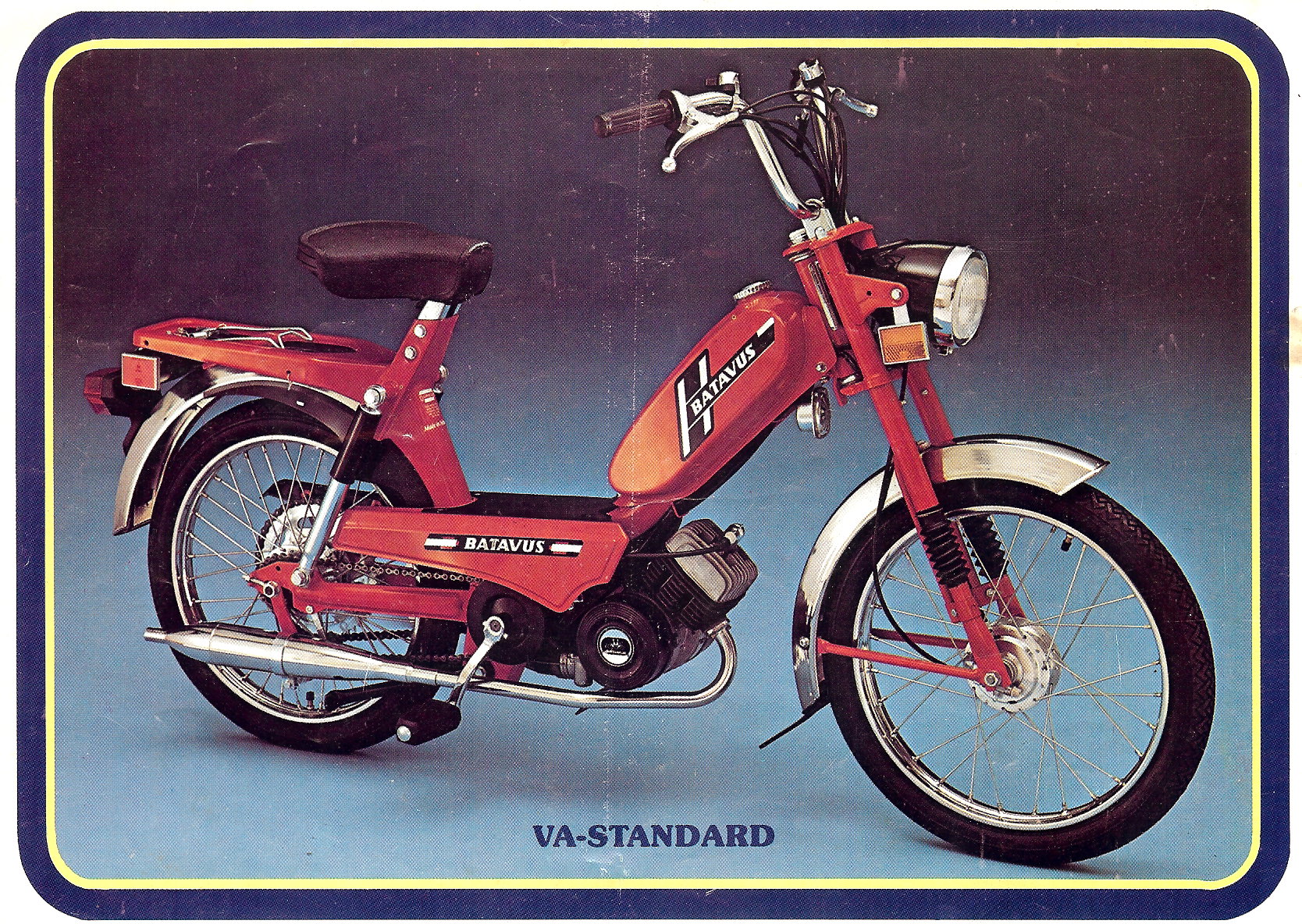
- 8 models with the Laura M48 motor were made available in the United States. The VA Standard, VA Deluxe, HS50, MoBat, Bingo, Badger, Bronco and some Starflites.
Batavus Moped Trike
- The VA Standard is available in four colors (red, yellow, orange, and violet), has a .95-gallon-capacity fuel tank, and originally retailed for about $429. The VA Deluxe model has all the features of the Standard, and it also has front and rear turn signals and a small battery attached to the carrier rack in the rear. The Deluxe sold in the 1970s for about $459. At the top of the Batavus line was the Model HS-50 that used the motorcycle style tank and seat design defying the more traditional step-through frame design seen in many other moped designs. The HS-50 can hold 1.3 gallons of fuel. Like the VA deluxe, the HS-50 is equipped with turn signals in the front and rear, and it has a rack-mounted battery. The HS-50 is available only in red. All weighed in at about 105 pounds.
- Some of the U.S. only models were equipped with the Laura M56 motor. which was powered by a toothed-belt and dry clutch. The Regency and some Starflites came with this motor. The Regency is known for it's extremely large top-tank gas tank that holds just under 3 gallons. The M56 is known for being slightly faster than the M48. The piston, reed valves, and certain clutch components are interchangeable between the M48 and M56 motors, otherwise, the motors are completely different.
- The Batavus Gran Prix mid-80's top-tank model, and the Mondial step thru model were equipped with a Peugeot 103 variator motor.
Resources
- Manuals - Owner's manuals for many Batavus models, plus M48 and M56 workshop manuals and dealer information.
Vintage Moped Manuals Wanted!
We looking for either quality PDF copies or original owner's manual booklets, literature, service and repair manuals and any other useful information that we can upload into our Manuals and Technical section and share with our readers and visitors. It has always been our policy that copies of these types of materials be shared and never sold. We would like to continue to build up a reliable and useful library of these types of materials and could use anything that you have and others may need. It is really hard to give proper ownership or copyright credit to any of these documents when I am not sure who to credit. If a document listed here belongs to you and was published without your permission, let me know and I will remove it from my site and offer you my sincere apology. If any of the original documents, diagrams, tool plans, wiring diagrams or links were of any benefit to you, please let me know as well so I can continue to add more similar items to my site. Thanks, Don General Moped Maintenance Sears Allstate (Puch) 2 Stroke Motorcycles and Scooters Sears Allstate (Puch) Twingle MotorcyclesAMFBatavusBermuda (Flandria) Cat Eye BL-700 Turn SignalsDerbiFrench (Misc early models) Foxi GT Garelli- Garelli NOI Single Speed Gasket Scan (Print out and Make your own gaskets)
 Honda
Honda - Honda Hobbit Rear Gearbox Gasket Scan (Print out and make your own gaskets)
- Kreidler Transmission Side Gasket (Print out and make your own gaskets) -Doug Wilhelm's
- Kreidler Clutch Puller (instructions to make your own)
Puch
- Puch Cobra, Maxi LS and AD 1984 Service Manual *****NEWEST UPLOAD****
Batavus Moped Repair Manual
SolexSolo OdysseySparta (see Foxi) TomosVespa/PiaggioGeneral 2 stroke Engine Manual